
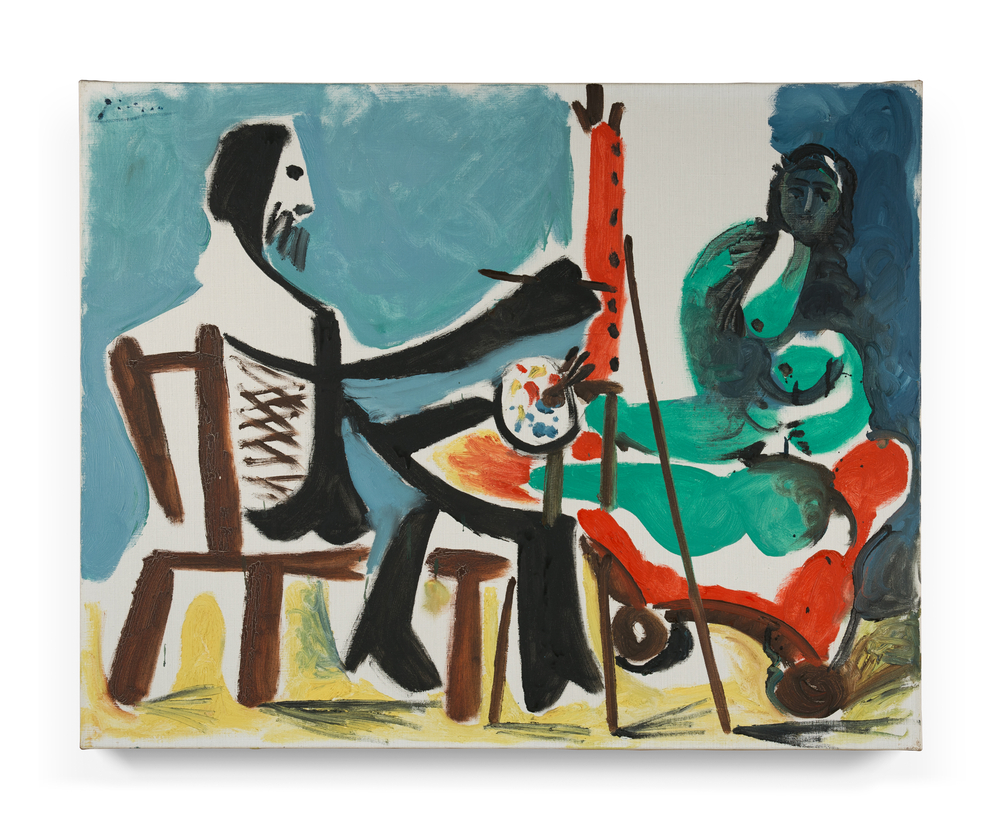
Pablo Picasso, Le Peintre et son modèle (The painter and his model), 1963, oil on canvas. © 2026 Estate of Pablo Picasso / Artists Rights Society (ARS), New York.
To look, to be looked at. This is where philosophy runs into trouble. “Hell is other people,” wrote Jean-Paul Sartre, referring to the imperious gaze of the Other and its alienating effect — the transformation of a person into an object. This is necessary, Sartre adds, for it is only by witnessing ourselves through another’s consciousness that we become aware of our own subjectivity, and thus our own vertiginous freedom. For Emmanuel Levinas, such an encounter — Me and You, Self and Other — was not a scene of existential anguish, but one of ethical demand: the degree to which I recognize the humanity of the person looking back at me is, ultimately, the measure of my own. In practice, however, that encounter has rarely been symmetrical.
Feminist theorists such as Hélène Cixous have interrogated the gaze — “the male gaze,” as it has been popularized — and its power to impose a rigid binary, neatly summed up by John Berger in Ways of Seeing (1972), describing the history of art:
Men act and women appear. Men look at women. Women watch themselves being looked at. This determines not only most relations between men and women but also the relation of women to themselves.
Berger published Ways of Seeing just shy of a decade after Pablo Picasso began the works in Nahmad Contemporary’s exhibition PICASSO | PAINTER AND MODEL, Reflections by Naomi Campbell. Opening in Gstaad on February 14, the exhibition comprises 14 canvases from the series Le Peintre et son modèle (The painter and his model), depicting an artist at his easel painting a nude woman. Though not specified as such, the artist is surely Picasso and the woman his second wife, Jacqueline Roque, whom he married in 1961.
Picasso met Jacqueline in the summer of 1952 in the French Riviera. She was 26 years old, a fresh-faced, strong-featured salesgirl at Madoura Pottery, where Picasso had been experimenting with ceramics since the 1940s. At the time, he was in a relationship with Françoise Gilot, but launched his pursuit of Jacqueline by drawing a dove on her house in chalk nonetheless. In 1954, Roque began appearing in Picasso’s paintings. He would go on to depict her more than any of his previous lovers. Of these depictions, the works from Le Peintre et son modèle are among the most consequential. Intimate and introspective, they stage and re-stage the encounter of the gaze, unsettling the assumed power dynamics. Who is really in charge here — the aging maestro, or the captivating young woman, who gazes back knowing she has him in her thrall? Or is this even a power struggle at all?
To be a model, to be a muse: this is its own type of action. PICASSO | PAINTER AND MODEL underscores this by placing Picasso’s paintings in conversation with Naomi Campbell, who knows a thing or two about being looked at. After gracing more than 2,000 magazine covers, Campbell likely needs no introduction. Still, here goes: scouted at age 15 in Covent Garden, she went on to become one of the original “supers,” walking every major catwalk and working with nearly every legendary fashion photographer. She was the first Black model to cover French Vogue. The first model, full stop, to get her own commemorative exhibition at London’s Victoria and Albert Museum. She is peerless.
Intriguingly, when Campbell is asked about navigating “the gaze,” her first instinct is to consider her own — the way her gaze operates as a conduit for a collaborator’s emotion. “The gaze can mean so many things, and there are so many different types of gazes,” she notes. “It comes from within — what your eyes transfer: the light, the sadness, the happiness, the seduction. You’re there but you’re not there.”
What Campbell describes isn’t far from what Cixous seeks from intersubjectivity: a bond of identification between Self and Other so close that the two enter a mutual process of becoming. “Muse, for me,” Campbell says, “is someone who’s dedicated to the creative, who trusts the creative, believes in the creative, loves the creative — and is just as passionate about seeing something come to life as the creative.” For creative read photographer, designer, artist. In Campbell’s case, a particularly apt substitution would be Azzedine Alaïa, with whom she shared a close personal and professional connection over many years.
Such relationships, she says, require “a lot of work.” They demand reinvention — to keep the creative engaged, to ensure that when he looks at you “he sees something new that he never saw before.”
“That’s a pressure,” she acknowledges. And sustaining that interest, Campbell adds, is rarely facilitated by being someone’s girlfriend or wife. Familiarity breeds boredom. “I think that’s even harder.”
Jacqueline must have been doing something to keep Picasso so ensorcelled, up in their villa in Mougins.
“He sat down and would just go with the feeling of what he had in front of him,” Campbell postulates of Picasso’s process. She finds a “sense of unknowing” in the paintings. Between him and Jacqueline, artist and muse, there may have been a simultaneous surrender of control. “You have to relinquish yourself,” Campbell says, speaking from the muse’s perspective. “I had to relinquish myself. I had to not take myself seriously. Risks, trying new things. Trust...and love.”
Power, desire, subjection — these were also at play in Mougins. But as Picasso’s 14 canvases in Gstaad assert, the dynamics between artist and muse are complex. His painter recedes. His model becomes a forceful presence. We can’t know what Jacqueline saw. But she made herself felt.
“The gaze can mean so many things,” Campbell reflects. “But the gaze is everything.”
PICASSO | PAINTER AND MODEL, Reflections by Naomi Campbell is on view 14 February–15 March 2026 at Tarmak22 in Gstaad
All quotes by Naomi Campbell are from a video interview conducted by Chiara Clemente for Nahmad Contemporary.