
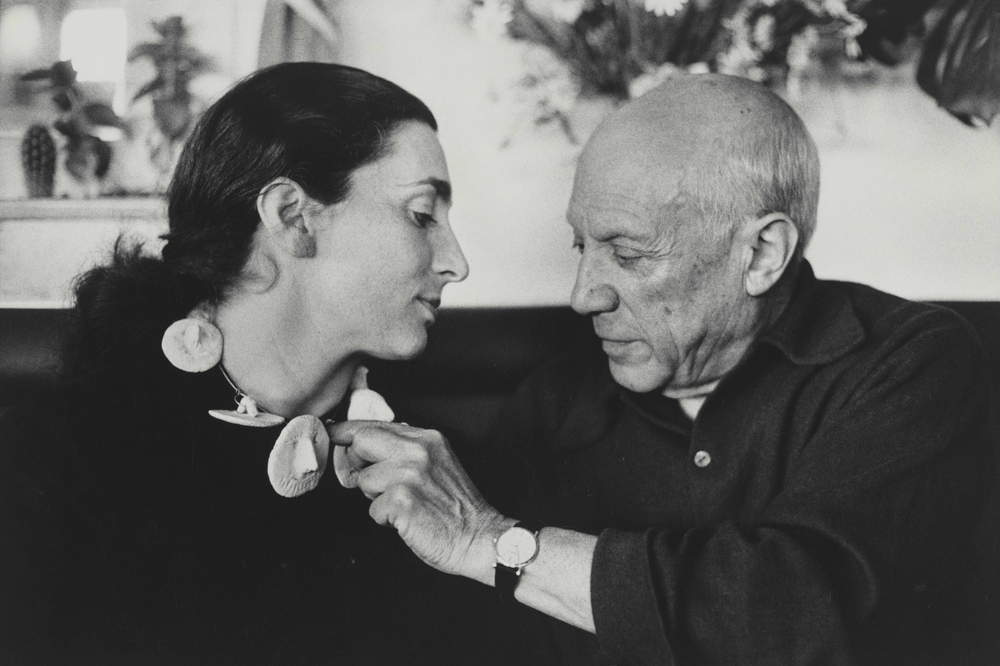
Pablo Picasso adjusting a necklace he made for Jacqueline Roque, 1957. David Douglas Duncan. © Harry Ransom Center, The University of Texas at Austin. © 2026 Estate of Pablo Picasso / Artists Rights Society (ARS), New York.
To understand Pablo Picasso’s work is to understand the women who shaped it. Across seven decades, Picasso’s major stylistic shifts unfolded not in isolation but in sustained dialogue with the women in his life — partners whose presence, companionship, intellect, and resistance continually recalibrated his vision. Far from interchangeable muses, they arrived at decisive moments of personal crisis, political upheaval, erotic awakening, and late-career reckoning. Each relationship opened a distinct visual and conceptual register, from Fernande Olivier’s role in the birth of Cubism to Dora Maar’s politically engaged Surrealist influence, from Marie-Thérèse Walter’s sensuous formal renewal to Françoise Gilot’s intellectual parity and Jacqueline Roque’s impact on Picasso’s late style. Below, their stories unfold individually, tracing how intimacy, conflict, and collaboration informed the evolution of one of the 20th century’s most influential bodies of work. Together, they reveal Picasso’s art as profoundly relational, inviting a reconsideration of the dynamics of authorship, power, and creative exchange at the heart of modernism.
FERNANDE OLIVIER
Born Amélie Lang, Fernande was Picasso’s first sustained muse and among the earliest to leave a written record of life inside his orbit. When they met in 1904 at the Bateau-Lavoir in Montmartre, Picasso was entering the Rose Period, newly committed to Paris, while Fernande — having recently changed her name after fleeing a violent marriage — was modeling within the city’s avant-garde circles. Over the next seven years, across more than 60 paintings, as well as drawings and sculpture, her image became a site through which Picasso tested a gradual move away from figural intimacy toward increasing formal severity. Described by her contemporaries as “la belle Fernande,” she possessed a striking beauty that Picasso readily translated into formal exploration. In early portraits such as Fernande à la mantille noire (1905), he renders her features with relative naturalism before transforming them into Iberian-inspired forms around 1906–07; he later acknowledged her influence on Les Demoiselles d’Avignon (1907). By the end of the decade, Fernande’s image was so fully absorbed into Picasso’s visual vocabulary that it became an ideal vehicle for reconstruction from multiple angles in Cubist paintings and sculptures, including Woman’s Head (Fernande) (1909) and Portrait of Fernande Olivier (1909).
OLGA KHOKHLOVA
A Russian-born dancer with Serge Diaghilev’s Ballets Russes, Olga met Picasso in Rome in 1917 while he was designing sets and costumes for Parade. Their marriage the following year coincided with the end of the First World War and marked a decisive social and stylistic turn for the artist. Newly embedded in Parisian bourgeois life, Picasso adopted a cool, disciplined Neoclassicism, producing some of his most refined portraits in the early years of their union. Rendered with elegant contour and compositional rigor — often seated, reading, or writing — Olga appears as a figure of restraint and introspection, her melancholy shaped in part by the political upheaval and personal loss in her native Russia. After the birth of their son, Paulo, in 1921, Olga inspired a series of serene maternal scenes informed by Picasso’s renewed engagement with antiquity and Renaissance form. As the marriage fractured in the late 1920s amid Picasso’s infidelity, his representations of Olga darkened. In Large Nude in a Red Armchair (1929, Musée Picasso, Paris), her distorted body registers emotional rupture and the collapse of domestic order. Though separated in 1935, Olga remained Picasso’s wife until her death in 1955.
MARIE-THÉRÈSE WALTER
Picasso met Marie-Thérèse in Paris in 1927, outside the Galeries Lafayette, when he was 45 and she just 17 — an encounter that quickly passed into legend and inaugurated one of the most sensuous periods of his career. Because Picasso was still married to Olga, their relationship remained concealed, and Marie-Thérèse entered his work obliquely, encoded through monograms and surrogate forms — often guitars or distorted figures — that functioned as metonyms for her body. By the early 1930s, however, her presence emerged with increasing clarity. Athletic, blonde, and distinctly youthful, she inspired a new visual language defined by sweeping curves, saturated color, and bodily ease. Her elongated profile and closed eyes recur across paintings, sculptures, and prints, most famously in the dreamlike portraits of repose and sleep that Picasso considered his most intimate mode of depiction. Works from the Bather series (c. 1927–32) and paintings such as Woman with Yellow Hair (1931, Solomon R. Guggenheim Museum, New York) translate her body into a site of renewal, reflecting the tranquility and seclusion the couple found at Boisgeloup. Following Picasso’s separation from Olga, Marie-Thérèse gave birth to their daughter, Maya. Though later eclipsed by new relationships, she remained a defining emotional presence in Picasso’s work.
DORA MAAR
Dora entered Picasso’s life amid mounting political crisis and personal upheaval, during a period he later described as one of the most psychologically fraught of his career — defined as much by creative paralysis as by external unrest. Born in France and raised in Argentina, she was a politically engaged, successful photographer closely aligned with the Surrealist circle when she met Picasso in 1935. Their relationship unfolded against the backdrop of the Spanish Civil War and the start of the Second World War. Both muse and artistic partner, she famously documented the making of Guernica (1937, Museo Nacional Centro de Arte Reina Sofía, Madrid), amplifying the work’s political urgency through her photographic reportage and sharpening Picasso’s own engagement with contemporary events. In Picasso’s portraits of Dora, a rigid, angular linearity — often likened to woven or striated surfaces — replaces the curvilinear sensuality of earlier muses. This visual language culminates in the Weeping Woman series (1937), where her fractured visage channels anguish, grief, and collective trauma. Yet the partnership was marked by imbalance and psychological strain. When Picasso eventually left Dora for Françoise Gilot, she suffered a breakdown and withdrew from public life. Her legacy endures not only in Picasso’s most searing images but as a singular artistic and intellectual presence whose influence shaped his political imagination.
FRANÇOISE GILOT
Françoise met Picasso in German-occupied Paris in 1943. A painter educated at Cambridge and the Sorbonne, Françoise was already exhibiting her work when Picasso — then 61 and still entangled with Dora Maar — introduced himself over a bowl of cherries at the restaurant Le Catalan. Their relationship developed into a decade-long partnership marked by intellectual exchange and artistic vitality. Françoise was never merely a muse: as Picasso’s biographer John Richardson observed, he took more from their relationship than she did. In his portraits of Françoise, the angular tension of the Dora years gives way to more sinuous lines and voluminous forms, seen in his 1946 graphite drawing at Musée national Picasso in Paris. Following the war, the couple settled in the South of France, where Picasso’s palette brightened and his work assumed a renewed sense of spontaneity and ease. Françoise appears repeatedly as a figure linked to nature — rendered with flowing contours and floral motifs that underscore her independence as much as her presence. Together they had two children, Claude and Paloma. In 1953, Françoise left Picasso, the only woman to do so on her own terms, later chronicling their life together with clarity, wit, and critical distance.
JACQUELINE ROQUE
Picasso’s final and most frequently depicted muse, Jacqueline, entered his life in Vallauris in 1952. They met at the Madoura pottery workshop, where Roque — recently divorced and raising a young daughter — worked as a sales assistant. As Picasso’s relationship with Françoise came to an end, Jacqueline became an increasingly constant companion, offering a quiet steadiness that contrasted with the emotional volatility of earlier years. Following Olga’s death in 1955, he and Jacqueline wed privately in 1961. Over the artist’s final, intensely productive decades, Jacqueline inspired hundreds of paintings, drawings, prints, and sculptures, her image permeating nearly every aspect of his work. Her long neck, almond-shaped eyes, and severe profile lent themselves to increasingly stylized, often bifurcated forms, becoming a structural anchor in Picasso’s late style. Her presence is prominently felt in his reworkings of Old Master compositions, including his Les Femmes d’Alger series (1954–55) and Las Meninas paintings (1957), where her strong features surface alongside broader questions of authorship, looking, and legacy. That same dynamic underpins the late Le Peintre et son modèle series (1963-65), in which the model appears less as a specific sitter than as a stand-in for Jacqueline’s sustained role as witness, counterpart, and constant within the studio. Living reclusively with Picasso at Notre-Dame-de-Vie, Jacqueline managed the rhythms of daily life that allowed his practice to continue at a relentless pace. After Picasso’s death in 1973, she assumed responsibility for his estate and legacy. She died in 1986 and is buried beside him in Provence.